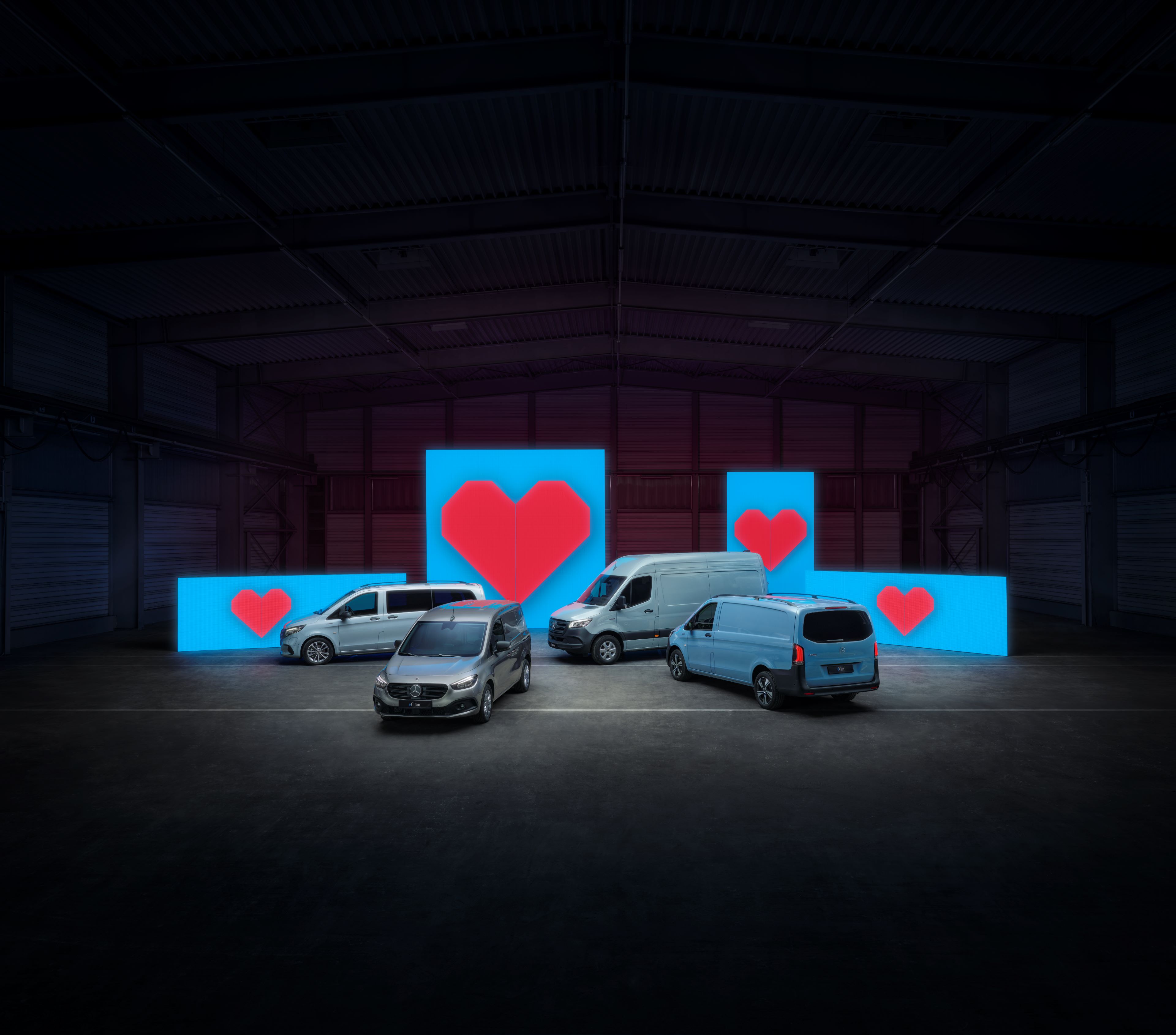
Uncompromisingly electric – electric mobility from Mercedes-Benz. Our vans with electric drive offer a completely new driving experience, and are as safe and reliable as you would expect from a Mercedes-Benz. This means no local CO2 emissions, near-silent locomotion and superior responsiveness. All in all, a forward-looking form of mobility that is reminiscent of the pioneering achievements of 130 years ago.
;Resize=(828,1639) "Electric vans | eSprinter, eVito and eCitan | Mercedes-Benz")
Heading for a fully electric future.
Suitable for everyday use, efficient and flexible. Discover the electric vans from Mercedes-Benz.
At a glance
The advantages of electric vans from Mercedes-Benz.
Especially for commercial vans in urban areas, electric mobility has many advantages to offer. Find out all about Mercedes-Benz's ambitions to become net carbon-neutral and how vans play an important role in the emission-free future of transport.
Switch now
Now is the perfect time to make the switch.
There are many good reasons for choosing an all-electric van. The switch can be a decisive step for your business. We understand that this step needs to be carefully considered; therefore, we've compiled some information for you about the practical advantages of Mercedes-Benz electric vans.
Vehicles
Our electric vans.
Be it spacious or compact, with particularly long range or extra payload – Mercedes-Benz vans with electric drive are so versatile that you're sure to find exactly the right vehicle for your business.
Ambition 2039
Our goals up to 2039.
By 2039, our entire fleet of new vehicles is to be net carbon-neutral along the entire value change and during the entire life cycle – from development, extraction of raw materials and production to the utilisation phase and recycling.
Electric drivetrain
Powerful technology.
The electric drivetrain is the centrepiece of Mercedes-Benz electric vans. Technologies customised to the respective vehicle and its intended use are used. What they all have in common is their high level of efficiency. Find out more about how the components of the electric drive work together here.
Digital Extras
Discover the Digital Extras from Mercedes-Benz
The Digital Extras let you get even more out of your Mercedes-Benz. Navigation and remote functions specially optimised for electric driving make your day-to-day work easier. Find out more about how the Digital Extras assist you with route planning, range optimisation and charging.
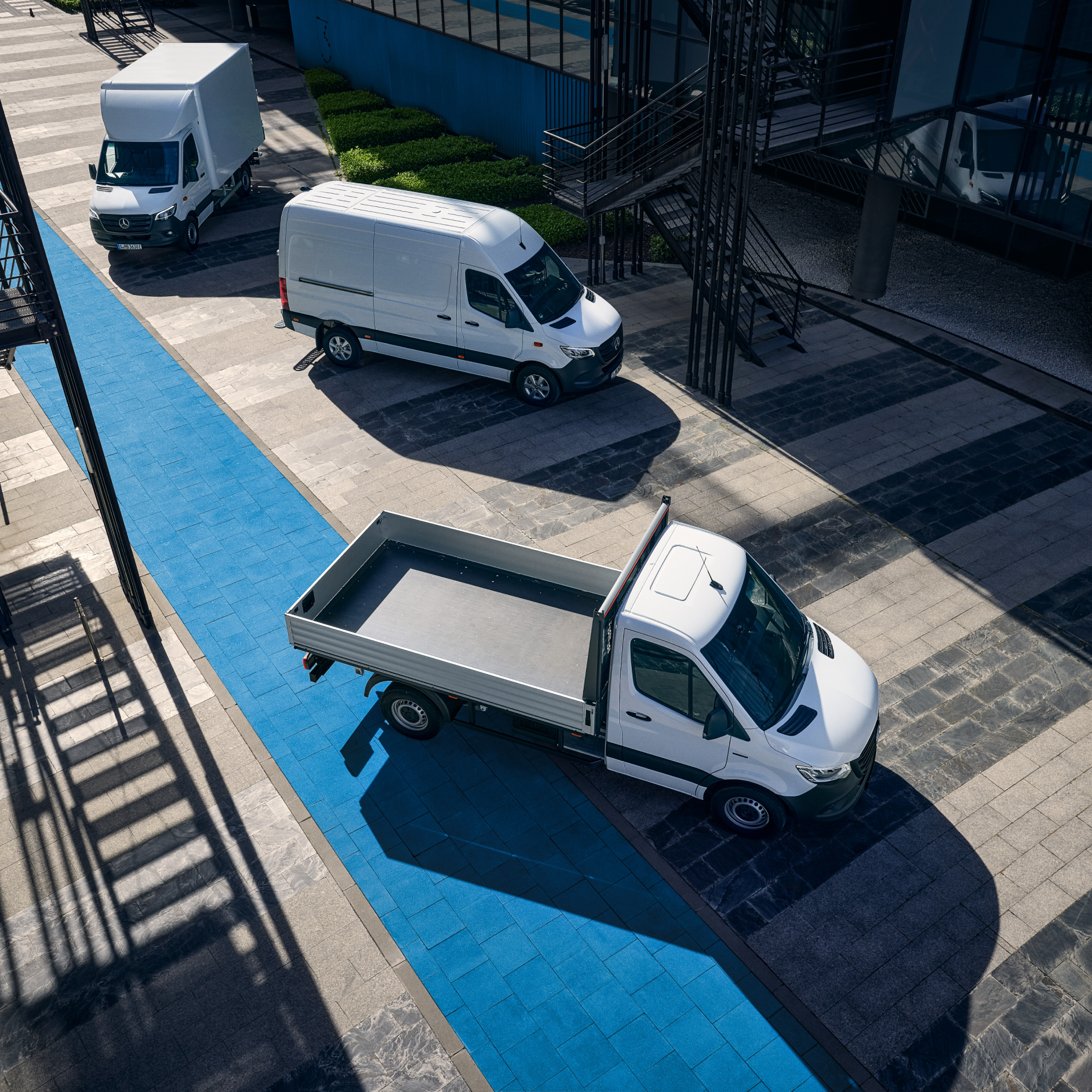
Discover the new eSprinter.
The most versatile electric van from Mercedes-Benz – with 3 battery variants, 2 motorisation levels and 2 vehicle lengths.
;Resize=(600,450) "eSprinter models | Mercedes-Benz")
Model overview
Our electric vans.
From compact shuttle vehicles for the city to goods transporters with a high payload – the electric vans from Mercedes-Benz are versatile, economical and suitable for everyday use. Here you will find the most important information about the available models.
FAQ
Questions and answers about electric vans.
Here you will find answers to the most important questions about the electric vans from Mercedes-Benz.
Charging points for electric vehicles use either alternating current (AC) or direct current (DC). How fast your vehicle can charge is specified in kilowatts (kW) and depends on the respective vehicle equipment. The higher the kW specification, the faster the charging process and the shorter the charging time.
Alternating current (AC) is supplied via the general power grid and is the most widely used charging method. However, it needs to be converted in order to charge high-voltage batteries. If the conversion is done using a wallbox, AC charging is possible with up to 11 kW, sometimes with up to 22 kW. The specifications for AC charging times, which you will find for the individual vehicles and battery variants, are also within this range.
Charging with direct current (DC) can be significantly faster. Depending on the vehicle equipment, your Mercedes-Benz can be charged with up to 115 kW in this way. This can significantly reduce the charging time – to the length of a coffee break, depending on the battery capacity. The DC charging time is usually specified for a range from 10% to 80%, as this can have a positive effect on the service life of the high-voltage battery. Incidentally, the charging cable is usually permanently installed at DC fast charging stations, so you don't need to bring a special cable with you.
The biggest influencing factor is the available charging capacity. In addition, the charging time can also be influenced by the current state of charge of the high-voltage battery. For example, it may take longer to reach the final percentage points until the battery is fully charged.
If you want to make your charging processes easier to plan, we recommend programming the charging settings: with this Digital Extra, you can use the Mercedes me App to specify a time when your vehicle needs to be ready with a certain state of charge.
In addition to the most important influencing variables – driving speed and vehicle air conditioning – the vehicle weight also has an impact on the vehicle's range. The triad of a forward-looking driving style, appropriate pre-entry climate control, and the unloading of unnecessary tools and cargo is therefore helpful.
In order to optimise the range, close-to-the-body systems such as seat heating or steering wheel heating should be used while driving. With these, the pleasant warmth arrives much faster than when the air is heated. However, you do not have to get into a cold vehicle in the morning or one that has been heated by the sun: with pre-entry climate control, you can bring your vehicle to the desired temperature before setting off – either via the MBUX multimedia system or via the Mercedes me App. As long as the vehicle is still connected for charging, no power from the high-voltage battery is consumed. Simply set the desired start time and temperature.
Electric mobility